Article: Battalion "Fluffy": The Cats and Dogs Living Through War With Ukraine's Soldiers
Battalion "Fluffy": The Cats and Dogs Living Through War With Ukraine's Soldiers
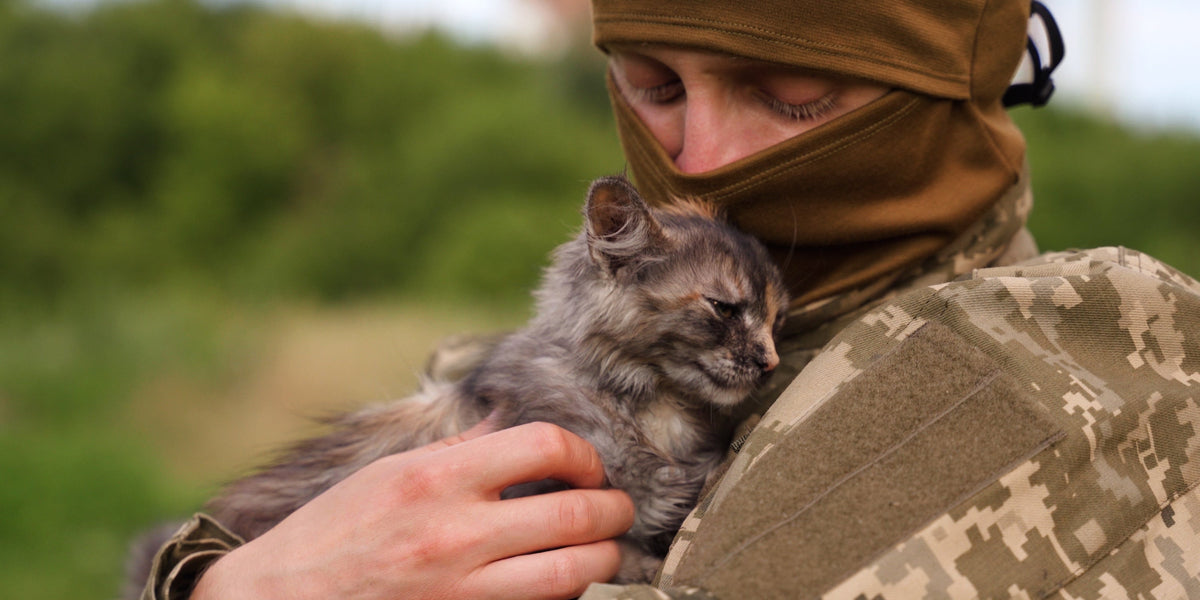
A cat curled up beside a soldier in a dugout. A dog pacing by the door, waiting for its unit to come back from a mission. A kitten pulled from a wrecked, empty village and carried to safety inside someone's military jacket.
By now, these images are almost familiar. They show up in soldiers' phone photos, in short videos shared from the front, in the quiet moments between everything else happening in Ukraine's war.
But behind each photo is a small, specific story — an animal that lost its home and its people, and a soldier who, in the middle of living through war himself, still made room to look after something even more vulnerable.
In 2024, those stories became something you can hold in your hand: Battalion "Fluffy," a Ukrainian collectible stamp series with one sheet for cats and one for dogs. And the story behind the stamps is worth more than a passing glance, because on the front line, these animals aren't just pets. They're companions, stress relief, pest control, unofficial guards — and, according to more than a few soldiers, an early-warning system that's saved them more than once.
How Frontline Cats and Dogs Find Their Soldiers
Most of these animals started out as someone's pet.
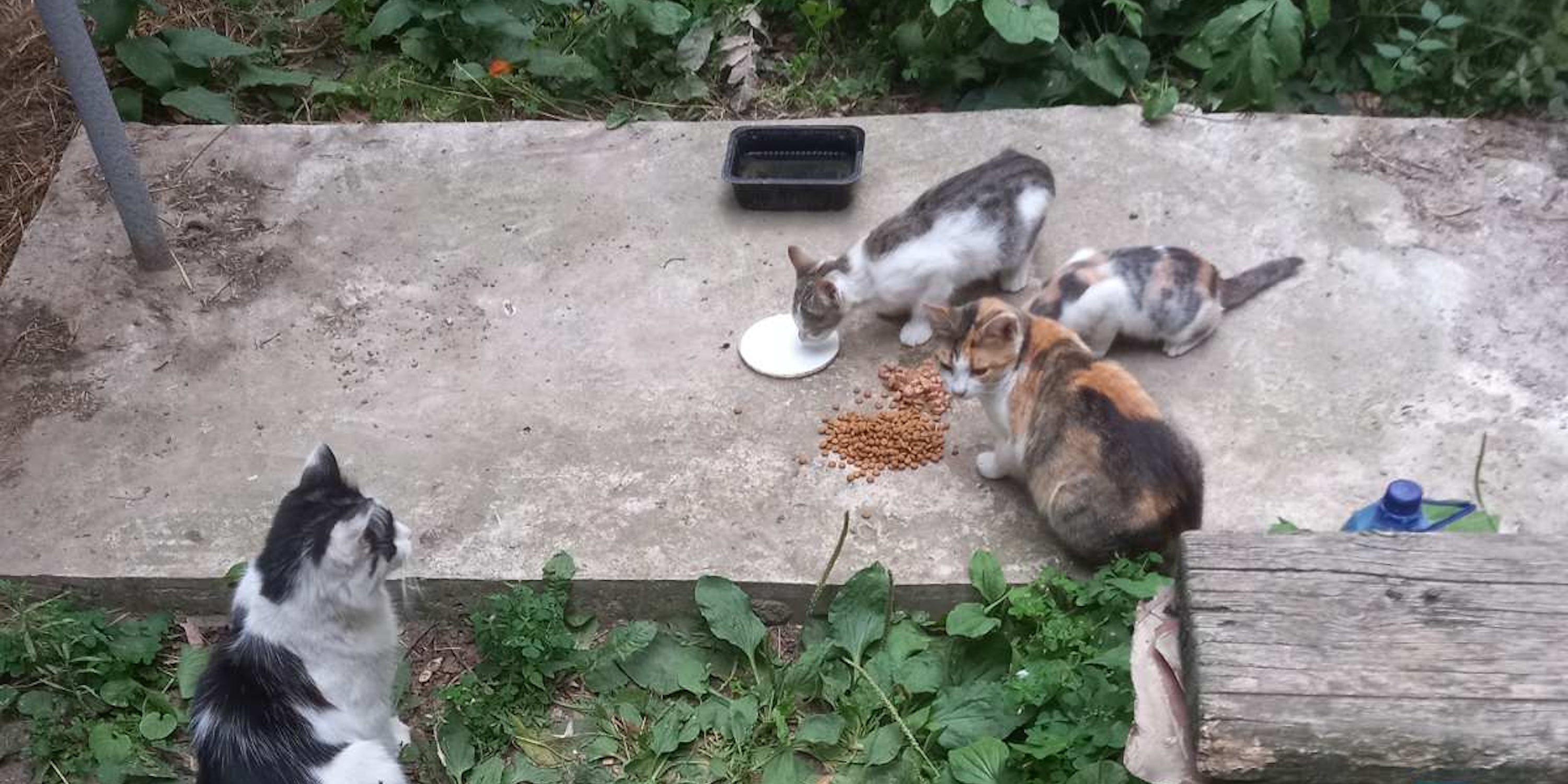
When shelling hits a village or a town, families often get minutes, not hours, to leave. Homes are destroyed, people are scattered, and in the chaos, pets get left behind or separated from their owners. Other animals are simply born into this new version of normal — abandoned houses, cratered streets, trenches, military checkpoints.
Sooner or later, many of them find their way to soldiers.
And soldiers feed them.
That's usually where it starts: a bit of food, a dry corner of a dugout to sleep in. It doesn't take long for that to turn into something closer to a friendship. A stray kitten becomes "the unit cat." A nervous dog starts sleeping curled against a soldier's boots. When the unit gets orders to move, somebody makes sure the animal comes too.
Some are eventually adopted out and taken home for good. Others stay with the military, passed along and cared for as new soldiers rotate through the position. Either way, they stop being strays. They become part of the battalion.
Can Dogs and Cats Actually Sense Incoming Shelling?
Ask around Ukrainian positions and you'll hear the same kind of story over and over: a cat or dog acting strangely right before — or during — an attack.
One Ukrainian border guard talks about his cat, Leo, who traveled with him to the front. Leo had a habit of suddenly bolting to hide or climbing a tree right as an attack was starting. Eventually, the soldiers around him learned to watch the cat as closely as they watched anything else.
Similar stories turn up at other positions, too: an animal gets restless out of nowhere, ducks into shelter, pins its ears back, refuses to go outside — and moments later, incoming fire hits.
So is this some kind of sixth sense? Probably not, at least not in the way it sounds. There's a simpler, more grounded explanation.
Cats have extraordinarily sharp hearing and can pick up frequencies well beyond what humans can detect. Dogs hear exceptionally well too, and can register sounds from much farther away than we can. That means an animal may hear distant artillery, aircraft, or drones — or feel subtle vibrations in the ground — long before a person notices anything at all.
For a soldier who spends every day next to the same cat or dog, a sudden shift in behavior becomes impossible to ignore. It's not a substitute for actual warning systems, obviously. But on the front, people learn fast to pay attention to anything out of the ordinary, four-legged included.
The Cats Have a Second Job: Keeping the Mice Out
Cuddles aside, cats at military positions earn their keep in a very old-fashioned way — they hunt.
Anyone who's ever tried to keep food safe from rodents knows the problem. Now picture storing bread, grain, rations, and gear underground, in a warm dugout, surrounded by open fields. Mice and rats find their way in fast, and once they do, they get into food, supplies, even equipment.
At a lot of positions, the resident cat is the most reliable pest control there is. One frontline cat named Mavik became something of a local legend among border guards for keeping his unit's dugout mouse-free.
None of this is new, really. Cats have lived on ships, in military camps, and around grain stores for centuries precisely because they keep rodents in check. Ukraine's trench cats are just the latest chapter in a partnership between people and cats that goes back a very long way.
The Job That Matters Most: Making War Feel a Little Less Like War
The biggest thing these animals do for soldiers is harder to put a number on. It's emotional, and it might be the whole point.
Picture weeks of explosions, drones overhead, cold, mud, and not knowing what tomorrow looks like — far from your family, your kids, your own pets back home. Then a cat climbs into your lap and starts purring. Or a dog sprints toward you, thrilled for no reason other than that you came back.
For a few minutes, the war just isn't there.
Soldiers have described these animals as companions, mascots, and — more than once — as their "four-legged antidepressants." Journalists who've visited frontline positions have heard the same thing again and again: these animals bring a kind of calm that's hard to find anywhere else out there. They're something ordinary in a place where almost nothing is.
They need feeding. They want attention. They fall asleep next to you. They make you laugh. They remind you of home. And maybe most importantly, looking after another living creature gives someone surrounded by destruction the chance to do the opposite — to protect, to care for, to save something.
Rescuer and Rescued, All at Once
That might be the most striking part of the whole story.
A homeless animal shows up looking for protection. The soldiers give it food, shelter, safety. And somewhere along the way, the relationship flips. The cat starts waiting for them to come back. The dog won't settle until it's curled up beside them. The soldiers start talking to the animal, playing with it, worrying when it wanders off, taking its photo like it's one of their own.
The animal they rescued ends up rescuing them right back.
That's the relationship behind Battalion "Fluffy" — Cats and Battalion "Fluffy" — Dogs, two Ukrainian collectible stamp sheets released in September 2024.
Battalion "Fluffy" Cats — Ukrainian Collectible Stamps
The Cats sheet holds six stamps, illustrated by Ukrainian artist Nataliia Kokhal. Each one celebrates a cat living alongside Ukraine's defenders — animals rescued out of the war who've become companions, mascots, and, in more than a few dugouts, genuinely useful mousers.
The original release also had a charitable component, with proceeds going toward animal shelters in Ukraine. For collectors, it's a sheet that captures a side of modern Ukrainian history that has nothing to do with weapons or front lines — it's about compassion holding on anyway.
Find the Battalion "Fluffy" Cats stamp sheet at Gifts from Ukraine.
Battalion "Fluffy" Dogs — Ukrainian Collectible Stamps
The companion sheet, also six stamps by Nataliia Kokhal, focuses on the dogs who turn up again and again in photos and footage from Ukrainian positions. Some were rescued from nearby villages. Some just showed up one day and never left. Others travel with their unit from position to position, wherever the soldiers go.
Friends, watchdogs, mascots, reminders of home — that's what they become.
Find the Battalion "Fluffy" Dogs stamp sheet at Gifts from Ukraine.
Together, the two sheets make a natural pair for collectors, animal lovers, and anyone drawn to the human side of the war in Ukraine.
The Stamps Did More Than Tell a Story — They Helped Real Shelters
There's one more reason this release stands out: it wasn't just symbolic.
Part of the price of each original stamp went directly to Ukrainian animal shelters. In the end, the campaign raised roughly UAH 1 million for shelters and rehabilitation centers, including facilities in Makariv and Hostomel.
So it came full circle — stamps inspired by animals rescued during the war ended up helping other animals in need.
A Quieter Kind of Ukrainian War Story
Most Ukrainian wartime stamps mark the big moments: battles, weapons, damaged cities, national symbols, the people defending the country. Battalion Fluffy is quieter than that.
A soldier splitting his ration with a stray cat. A dog asleep by the dugout entrance. A kitten keeping the mice out of the food stores. An animal that suddenly won't come out of hiding. A soldier coming back from a hard mission to find a familiar face waiting for him.
None of it looks like much next to everything else going on. That's probably exactly why it matters. Even somewhere built to strip compassion away, people keep finding room to care for something smaller and weaker than themselves — and the animals give it back, in whatever way they can: loyalty, warmth, an early warning, a mouse-free dugout, a bit of company on a bad day.
The Battalion "Fluffy" Cats and Dogs stamp sheets hold onto that. For collectors, animal lovers, and anyone who wants to support Ukraine, they're not really about postage at all. They're a small, honest piece of what resilience looks like up close.
🇺🇦 Explore authentic Ukrainian collectible stamps and meaningful gifts from Ukraine at Gifts from Ukraine.
Written by Elena Volkova