
Artículo: Harvesting Under Fire: The Ukrainian Farmers Who Refuse to Leave Their Land
Harvesting Under Fire: The Ukrainian Farmers Who Refuse to Leave Their Land
There is something deeply familiar about harvest time in Ukraine.
Golden wheat. Endless sunflower fields. Combines moving slowly across the horizon. Trucks filled with grain. Dust hanging in the warm air.
For generations, this has been part of the rhythm of Ukrainian life.
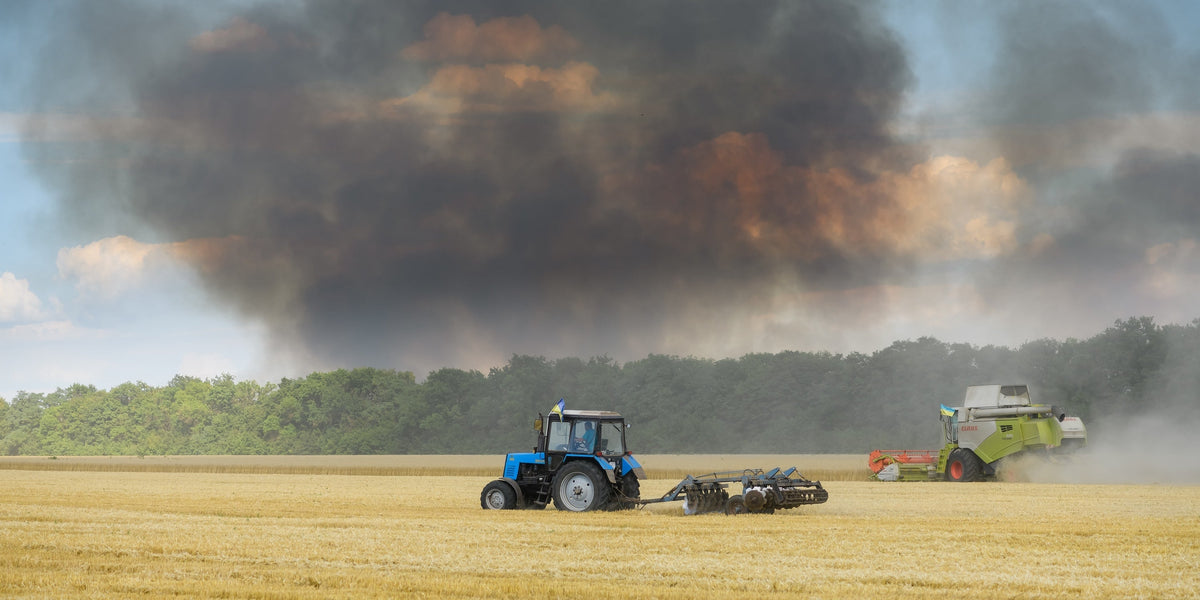
Today, in many parts of the country, the harvest still happens. But the people bringing it in may be working beside mined fields, listening for artillery and watching the sky for Russian drones.
In southern and northeastern Ukraine, this is not a figure of speech. People are being hunted from the air.
Human Rights Watch documented Russian drone operators tracking civilians in Kherson and attacking people as they walked, drove, cycled or went about their everyday lives. Farmers harvesting crops are among those who have been attacked. Some drones follow their targets before striking.
And yet the fields are still being planted. The wheat is still being cut. Ukraine is still harvesting.
A Country That Keeps Growing Food
Despite the full-scale war, mines, destroyed equipment, damaged storage facilities, labor shortages and difficult weather, Ukrainian farmers harvested 57.6 million tonnes of grain and 17.3 million tonnes of oilseeds in 2025. Ukraine produced around 23.5 million tonnes of corn and approximately 9 million tonnes of sunflower seed.
Those are enormous numbers. But numbers can make us forget what a harvest actually means. Every tonne starts with somebody going into a field.
In Odesa, Kirovohrad and Vinnytsia regions, farmers were among the country's harvest leaders during the summer of 2025. Later in the season, Chernihiv and Poltava were also producing millions of tonnes of grain.
In frontline regions such as Kherson, Sumy and Kharkiv, however, the same work can involve an entirely different calculation: Is the field mined? Is it safe enough to send the combine out? Is there a drone overhead? How long do we have before the next shelling?For some Ukrainian farmers, these have become ordinary questions before an ordinary day's work.
Kherson: Fighting for Every Harvest
Perhaps nowhere is this reality more visible than in Kherson region.
This is some of Ukraine's most important agricultural land. It is also land that has lived through Russian occupation, destruction, flooding, extensive mining and continuing attacks.
After the liberation of the right bank of Kherson, farmers began returning. They found fields contaminated with mines and unexploded ammunition. Equipment had been damaged or stolen. Buildings and irrigation infrastructure had been destroyed. Still, they came back.
Farmers began clearing land and trying to grow crops again — sometimes with professional demining assistance, and sometimes taking terrifying risks themselves because waiting another season could mean losing the farm completely. And now there is another threat: drones.
A tractor or combine is large, slow and easy to see from the air. But the target is not always simply the machine. Russian drones have attacked the people working in and around the fields. Human Rights Watch has documented a broader campaign of Russian drone attacks against civilians in Kherson, including farmers during harvest.
Some Kherson farmers now work with electronic warfare equipment. Others have armed themselves.
Imagine having to protect a combine from drones simply to bring wheat home.
Oleksandr Hordiienko: A Farmer Who Would Not Give Up His Land
One of those farmers was Oleksandr Hordiienko.
He had worked the land in Kherson region for more than 30 years and headed the Kherson Oblast Farmers' Association. After the occupation, he returned to his fields. There were mines everywhere. According to his daughter, Hordiienko removed thousands of anti-tank mines from agricultural land. He protected his workers and machinery, used electronic warfare equipment against drones and even went into the fields with a shotgun to bring Russian drones down.
A reporter visiting Kherson farmers in 2025 described Hordiienko talking about fighting drones almost matter-of-factly. He said they mostly used electronic warfare, but he had also learned to shoot them down. His farm had already brought down a large number of them.
There is something almost impossible to comprehend about that picture. A farmer should be thinking about rainfall, soil, machinery, fuel and the price of grain. Instead, he was thinking about mines beneath his fields and drones above them. And he kept farming.
On September 5, 2025, a Russian drone struck Hordiienko's vehicle while he was working in the field. He was killed. He was 58. His story is extraordinary. But in today's Kherson, the determination behind it is not unique. There are many people whose names we will never know who continue driving tractors, repairing machinery, tending animals and harvesting fields close to the front.
Sumy: Farmer One Day, Soldier the Next
Travel north to Sumy region, close to the Russian border, and the details change, but the story is strangely similar. Mykola Mondrayev, 55, is both a farmer and a member of Ukraine's territorial defence. Three days a week he serves with his defence unit. On the other days, he works his fields.
When The Guardian visited him in 2025, the wreckage of a Russian drone lay in a field nearby. Even more than 30 kilometres from the front, the possibility of another attack was part of daily life. Nearby farmer Mykola Panasenko grows rye, oats and sunflowers and raises sheep. Russian drones struck his barn and office in two attacks just a week apart. He now hides his tractor beneath trees when he is not using it, hoping it will be harder to spot from the air. But his concern isn't only for his own farm.
Small farms support entire rural communities. They employ local people. They buy and sell locally. They supply mills. Families depend on them for seed, livestock and income. Without farms, villages begin to disappear.
“I Don't Know What Will Happen Tomorrow”
Another Sumy farmer, Andriy Sema, worked about 150 hectares. Before the invasion, he employed five people and raised around 150 pigs. By 2025, the workers were gone and most of the livestock business had disappeared. He was managing the farm largely alone, with help from his son, growing rye and sunflowers. A Russian drone had fallen on his land. He told reporters that drones could be heard almost every day and that farmers constantly heard about another farm being hit. What wore him down most was the uncertainty. Not knowing what would happen next month. Or tomorrow. Or even later that same day. And still he was farming. That is an important part of this story. Courage does not always look dramatic. Sometimes it looks like getting up in the morning and doing the same job again when you have every reason to be afraid.
The Fields Have Become Their Own Front Line
Larger farms face the same danger.
Serhiy Bondarenko, whose agricultural company operates in the Sumy region, described trying to find short windows between attacks when workers could safely enter the fields.
The company has its own security team. They check conditions, communicate with the military and carry anti-drone equipment. Only then can workers be told that it may be safe enough to begin sowing.
Bondarenko described the fields as their own kind of combat zone. But there is no possibility of simply waiting for the war to end. Wheat has to be planted at a certain time. Sunflowers have to be harvested when they are ready. Animals have to be fed every day. Agriculture does not understand war schedules.
Mines Beneath the Soil
The danger does not disappear when the drones leave.
Across formerly occupied and frontline areas, mines and unexploded ammunition remain buried in agricultural land.
A field can look completely normal from the road — green in spring, golden in summer — while hiding something deadly underneath.
That means liberating Ukrainian territory does not automatically return it to the farmer.
First it has to become safe enough to walk on.
Then safe enough for a tractor.
Then safe enough to plant.
And only months later, if everything goes well, there may be a harvest.
This makes every field returned to cultivation in Kherson, Mykolaiv, Kharkiv and other affected regions a small act of recovery.
The war has even created an extraordinary new Ukrainian story: bread baked from wheat grown on demined fields in Kherson and Mykolaiv regions. In 2025, the Soul of Soil 2.0 project used grain from cleared farmland to make traditional Easter bread, drawing attention to the enormous task of returning contaminated Ukrainian land to life.
There could hardly be a more powerful symbol.
A minefield becomes a wheat field again.
And eventually, the wheat becomes bread.
Why Ukrainian Farmers Keep Going
People outside Ukraine sometimes ask a reasonable question:
Why stay?
Why risk your life for a field?
There isn't one answer.
A farm isn't something you can simply pack into a truck and move to another part of the country.
The land may have belonged to a family for decades.
The farmer knows that soil. The machinery is there. Employees and neighbours depend on the business. The village depends on it. Livestock cannot simply be abandoned.
And there is something deeper as well.
For Ukrainians, the land has never been merely an economic asset.
Ukraine's чорнозем — its famous black soil — is part of the country's identity. So are wheat fields, sunflowers, orchards, vegetable gardens, beehives and the small farms surrounding villages.
This is why images of Ukrainian wheat and sunflowers carry so much meaning.
They are not just beautiful landscapes.
They are home.
Every Harvest Is an Answer
Russia has occupied agricultural land, mined fields, destroyed grain facilities, attacked farms and targeted the people who work them.
Yet Ukraine harvested tens of millions of tonnes of grain in 2025.
There is something quietly defiant about that.
Someone cleared the field.
Someone repaired the tractor.
Someone found seed and fuel.
Someone checked the sky.
Someone climbed into a combine.
And someone brought the harvest home.
Not every one of those people will receive a medal. Most of their names will never appear in newspapers.
But together they are keeping Ukrainian villages alive and keeping Ukrainian land productive.
They are also making sure that a country at war can still produce bread.
Bread at the Cost of Life
In November 2025, this story was commemorated in a new Ukrainian postage issue called “Heroic Professions. Bread at the Cost of Life.”
Its central inspiration was Oleksandr Hordiienko.
The official description tells of farmers who continue sowing and harvesting despite mined fields and constant attacks, and of Hordiienko clearing farmland and defending his fields from Russian drones before a drone took his life on September 5, 2025.
Only after knowing these stories does the title really sink in:
Bread at the Cost of Life.
It isn't a slogan.
For some Ukrainian farmers, it has been the reality.
The Bread at the Cost of Life – Ukrainian Stamp Sheet, 2025 is now available from Gifts From Ukraine.
It is a small piece of contemporary Ukrainian history — a tribute to Oleksandr Hordiienko and to thousands of farmers who continue working the land through a war.
To Ukraine's Farmers 💙💛
To those planting in demined fields, harvesting under drones, rebuilding destroyed farms, tending animals and returning to the land again and again:
Thank you.
And to people around the world who have not grown tired of Ukraine — who still pay attention, still care, still support Ukrainian people and Ukrainian businesses — thank you too.
Ukraine is still fighting.
Ukraine is still planting.
And Ukraine is still bringing in the harvest.

De Elena Volkova

Dejar un comentario
Este sitio está protegido por hCaptcha y se aplican la Política de privacidad de hCaptcha y los Términos del servicio.